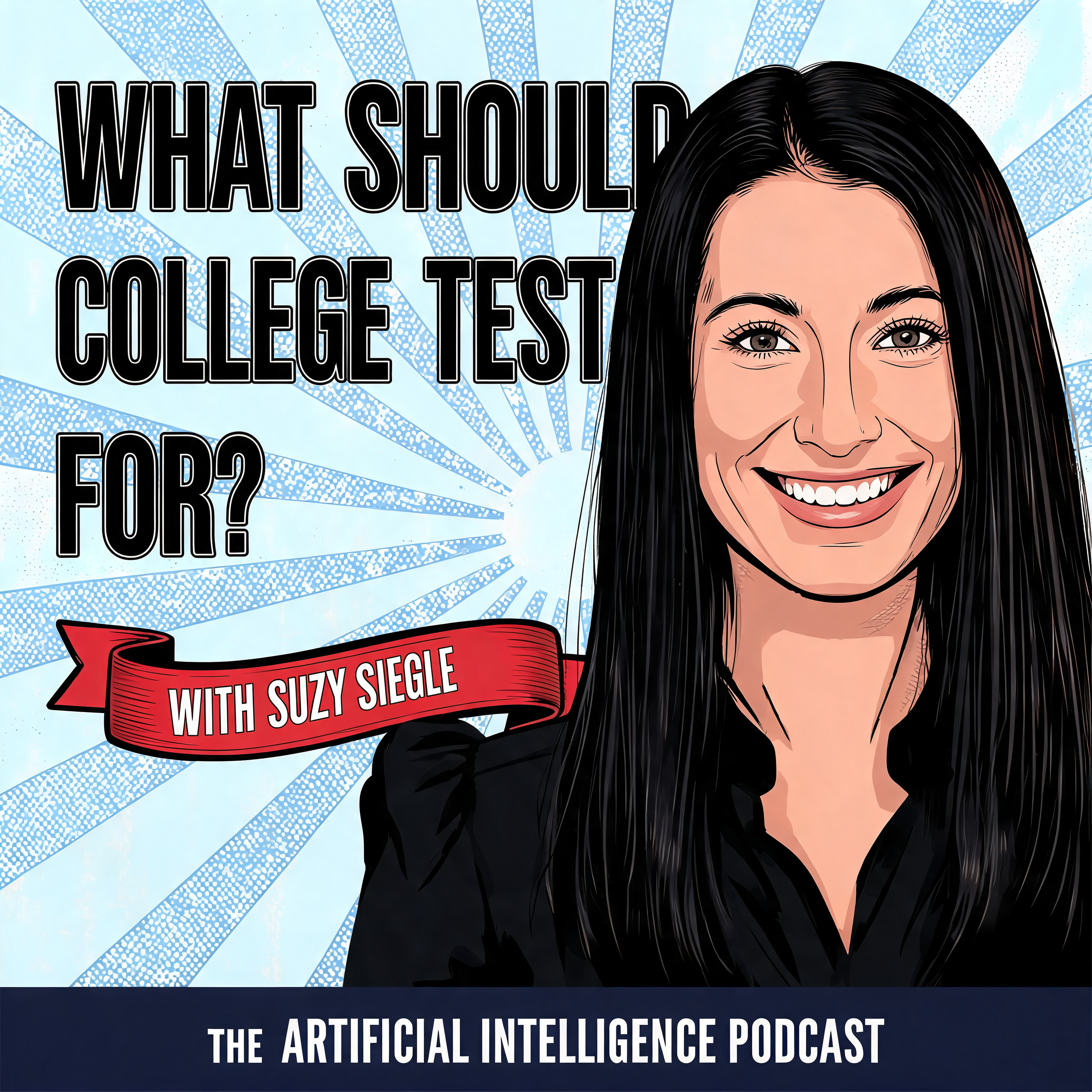
Students can now ask an AI anything a lecturer used to explain, which raises an awkward question for anyone running a university. Suzy Siegle is President and CEO of Walsh College — founded in 1922 by Mervyn Walsh, who was Thomas Edison's accountant — and she is not defending the old model. She teaches her own doctoral course, grades close to fifty students with workflows she built herself, and argues this is a disruptive innovation, not a bolt-on: horse-and-buggy to car, Blockbuster to Netflix. Jonathan Green talks with her about what you test for when the exam is solvable, the three things employers now ask about graduates that nobody asked four years ago, the broken first rung of the career ladder, and why she thinks the fear is a mirror worth looking into.
Key Takeaways:
- Teach the thinking, not the tool. Suzy earned a law degree, and much of the law she learned has since been overturned — what lasted was learning to evaluate a situation from both sides before concluding. Same principle now: students learn to work with amplified intelligence as a thought partner, so the skill survives the next model release.
- When AI can pass the exam, you test for critical thinking, problem solving, innovation and grit. The lecture content can be self-serve; the live session is for connection, argument and masterminding — the part that only works with humans in it.
- Employers are asking three new things: is this person adaptable rather than attached to a job description, can they use AI to genuinely save time and money rather than just draft emails with it, and do they have the grit to push through to the tipping point instead of leaving at the first hard stretch.
- The entry-level rung is not just changing, it is disappearing — and the answer is to stop separating school from work. Walsh's students are already employed and apply the learning on the job, so they graduate with the credential and the experience instead of facing the old riddle of an entry-level posting that demands three to five years.
- Expect more human time, not less. Once AI absorbs the tactical work, the scarce and valuable things become the conversation, the mastermind, the alumni community — and Suzy runs her own role without a full-time assistant specifically so she can spend that time on students.
Notable Quotes:
"When you have a mission bigger than the fear, you will pull yourself out." — Suzy Siegle
"Get as much education as you can as quickly as you can. Run through school, don't walk." — Suzy Siegle
Connect with Suzy Siegle:
LinkedIn: https://www.linkedin.com/in/suzysiegle
College: Walsh College — https://www.walshcollege.edu
Enjoyed this? Follow The Artificial Intelligence Podcast and send it to anyone deciding whether the degree is still worth it.
Full transcript
battle between artificial intelligence and higher education With our amazing special guest, Susie Siegel. Susie, thank you so much for being here. I'm so excited to have a CEO of a university on the show finally, bringing together the two worlds of business and education. And just as we get started, I'd love to get your perspective on how students can learn about AI At the same time as it's changing so fast, it's almost changing faster than the classroom can keep up. Jonathan, absolutely.
Thank you so much for having me. And that's a great place to start. So that's really important because while we are teaching students how to use AI, and these are, multiple AI systems, way beyond just chat GTP, right? We're going into perplexity, into gamma, into Claude, into building workflows. We are training them on how to think with amplified intelligence as their thought partner. Okay. So let me liken it to something in my background. I have one of my degrees is a law degree.
And I earned that years ago. And a lot of the law that I learned has been changed, either overturned by case law or legislation. But the real value in the legal education was learning how to think like a lawyer, how to evaluate a situation from both sides before drawing a conclusion.
So now with artificial intelligence and machine learning, we are training up our students how to use these amplified tools that will change, that will grow, that by the end of the semester or the year are going to adapt. so that they can be AI creators, powerhouses, users, no matter what the system is and no matter how much it changes. So that's a very important piece. We're not just teaching them, here's how to use the tool today.
We're teaching them here's how to incorporate it to your amplified workflow of intelligence so you can scale and save time and money. A lot of people now have already switched to their AI is their best friend, their AI is their teacher, and so they go, I don't need to buy a course or go to university. My AI can teach me. And now that a student can ask their AI assistant anything that the lecturer used to explain.
What do you think a business degree gives a student now that artificial intelligence just can't? Yeah, no, absolutely. So I think it's a complementarity, right? So what you said is really important. And that's going to be a question that higher education is facing today, tomorrow, and into the future. the democratization of learning, we saw it a little bit with the internet, with Google, with SEO. Students were able to go online and learn things, right?
Remember the days of Wikipedia and the debate about is that valid, is it not? And even the database systems that we use in higher ed for research. So now what you have is you have artificial intelligence and machine learning amplifying that database. So that does shift and change how we teach and learn. I'll give you an example. In my doctoral class, so I teach a doctoral class called High Performance Leadership. We don't need me to go through a slide deck and deliver the didactic content.
The students can grab that in the course management shell. They can use artificial intelligence to research some of the terms, to ask it. Why did you do this? Why are you thinking this way? Explain locus of control. That's a central theme in my course and high performance leadership. And then when we get together once a week on Zoom, synchronous like this, and it's it's recorded.
So if you can't come live, you can listen to me on the replay and the and the course on the replay and the classmates. When we get together, it's really for connection, community, engagement, discussion, masterminding.
So that's how colleges are going to respond, and that's how Walsh is responding. in this age of AI to say we want you to use AI to challenge assumptions, to look at blind spots ethically and responsibly, and we want you to engage with your faculty and your colleagues, your classmates, your peers so that you can really deep dive and evaluate and connect, which is the essence of the human being in the amplified intelligence world.
When I've been doing recruiting and trying to hire coders and developers, the questions we ask now have changed so much because they can just use Chat GPT to answer the questions. So sometimes I'll ask a question like, When you were solving this problem, how did each part make you feel? And ChatGP is not ready for that one. So they have to give a real emotion. And so that separates the people that were really frustrated solving a bug versus the people that are just reading an answer.
Yes. When well at universities, when artificial intelligence can pass the exam. How do you change the testing method and what do you test for instead? Right. So that's exactly the question when we ask, what are we training the workforce for today and tomorrow for? Critical thinking, problem solving, innovation, and grit. So when we get an answer in the real world, so let's let's pretend we're in this world of of a business boardroom, right? And let's say we have amplified intelligence.
I'm a Star Trek fan, so I think of data from Star Trek, the next generation, right? And he's giving an answer. Now in Star Trek, for example, and I know that was years ago, but it was very prophetic. You still had the captain, you had other crew members that would then ask data, would challenge data, would ask them to do tasks faster so they could get the data and decisions or the data to inform their decisions.
So this is really the core of amplified intelligence, the complementarity between the human being and AI. It will change what we're teaching and how we're preparing students for the jobs of the future. And I know we're gonna talk about that in a second, is how does this actually impact the jobs?
Make no mistake, Jonathan, this is a disrupted innovation. we talk about sustaining innovations like the cell phone, the iPhone 18, even the iPhone folds coming out is still an incremental improvement and innovation on an existing technology that we have integrated in our lives. But a disrupted innovation is like the horse and buggy to the car, right? It's like blockbuster video to Netflix. It changes the entire foundation of how we work, live, communicate, collaborate, and succeed. So this is not going to be a bolt-on solution.
This literally is changing the very fabric and core of how we work. And what's exciting is at places like Walsh College, we embrace this, we teach this, we build it into the courses. In fact, in one of the doctoral courses taught by our incredible provost, Dr. Dave Skippers, who is a thought leader and AI architect in executive education, he teaches students how to create a digital twin of themselves so they can use that digital twin to amplify workflows, do assist with research, development, analysis.
That's how this will change. And the colleges that embrace this and teach it are going to be preparing the leaders of tomorrow. So you brought up a couple of issues I want to dive into. the digital twin thing for me, I built one a few years ago and I hated him. I was like, my gosh, this is too much of me. There's only room for one of us. And he was too willful, just like me. That's the problem. He was doing exactly what I would do.
So it's like seeing a reflection of your worst, the things you like about yourself the least. And I couldn't tame him. I was like, all right, well, you gotta go, buddy. But I'm really interested as well in how hiring is changing. And what question are employers asking you about graduates now that nobody was asking three or four years ago? Yeah, okay. So I love that you you booted your own digital twin. And when we say a digital twin, you're you bring up a good point.
You're not creating a replica of the way you think. You're creating an amplified complement to how you think. So it will look for things like evaluate this, test assumptions, how would this land with people who are more intuitive versus analytical, right? Because I will I will speak into this for a minute, which goes right into the next question. So much of business and success.
Is being able to work with others and communicate with others and what we have, what we call cognitive flexibility, the ability to adapt, to be cognitively flexible with how we speak, how we email, how we communicate, and then to read the room. How many times have we seen that, right? On social, read the room. And that is that human element that we can then really begin to have the amplified intelligence evaluate. And there's so many people that do that.
They'll run their emails and their communications through AI and say, Look for blind spots. How would this land? So when we talk about what I'm hearing from employers, these are the things I'm hearing. Number one, they want adaptable individuals because they know the jobs of today are changing for tomorrow. So if a person comes in and they're like, This is my job description, this is all I want to do. Don't ask me to do anything outside of it, that's not an adaptable employee.
So really it's being able to think almost like a renaissance person and adapt. Number two. Can they utilize artificial intelligence to actually save time and money? This goes beyond just, okay, are they creating emails with chat GTP? Are they just using AI to do their job? Or are they using AI to really take their job to the next level?
And can they build out departments and teams without adding the same number of people that we might have had to add before? even thinking about the C-suite and Dr. Skippers, our provost, talks about this a lot. how AI will even change the way executive leadership is structured in organizations, because it's not necessarily about hiring all these folks and then bringing AI on. It's really integrating AI into the hiring, the mentoring, and the development.
And the third thing we're hearing is they need folks that have grit and determination because many times in life, you you have to push through the difficult times to get to the success. And what they're seeing is if there are a lot of folks that are shifting jobs or changing or they're coming in with one expectation and then leaving, they're not hitting that tipping point of success.
So having the ability to integrate and use AI to truly save time and money and advance the company forward, being adaptable, being able to pivot with the job, being able to integrate different skill sets and being committed to continuous lifelong learning.
You bought up what I think is a really big issue, which is interpersonal communication and the ability to talk to people, more and more people are speaking through filters and layers. they only order pizza through an app because they don't want to call Because maybe the person will judge them. They don't want to go to a restaurant if you have to call to make a reservation. Because maybe the person will like, I guess it's a constant fear of judgment.
But I know people like this who like there are certain things they will never do because they fear confrontation. And I said, if you call and order a pizza, you're not gonna have a confrontation. I'm a lot of my friends. I worked at Toys R Us, that was my first job. A lot of my friends did that. And it's like they were just thinking, I want to get through this, not judging every order. Like they couldn't care less about you. But We create that.
And so I've noticed, especially now that people are creating parasocial relationships with AI, which is another big worry, that interpersonal communications are starting to become a rare skill. the ability to have a normal conversation without getting distracted and actually making eye contact is becoming rarer and rare and rarer. Is that something do you think that the ability to come into the office when everyone else wants to work from home and the ability to have these interactions that are non-confrontational that just, hey, how are you doing?
Or writing the elevator with someone else, is that gonna start to become another critical skill as we spend too much time one on one with an AI that writes all my emails, writes all my texts and translates all the emails that I get? Yeah, I know it's a great question. I was thinking about the pizza thing. I'm thinking, okay, I have door-dashed ice cream and cookies before, mostly for convenience because I didn't want to go in, right?
On those days you really want the comfort food. my goodness. yeah, so I didn't think about it that way. That's a very good point. That I I think a couple things. One is, you know, let's let's look at how we have adapted to technology, disruptive technology before. Okay. So let's say, for example, we told people you can't you have to do your job.
Or let's say we tell a student you have to go to school, you have to turn in assignments, but you cannot use a computer, you can't type anything. Well, they would look at us and say, It's impossible. Think about that, right? Right? remember the days we used to, I remember the days I used to hand write papers and turn them in. There was no electronic copy, there was no email.
Now, maybe when you got the computer, you typed and then you hit print, and then the little dot matrix would print it out, and then you'd submit it all typed and printed, right? But what has happened is our jobs and our school and our learning have adapted around that disruption of the computer, the email in a good way. And so now that has become part of almost a job necessity.
I can't think of a job unless even when you are working on the floor in retail or on food service, you still have something in front of you that has a computer, that has some sort of digital way of communicating. So how humans adapted to that. Was yeah, there probably was less handwriting. There was less long division. Handwriting got messier. I don't even know if they're teaching cursive in school. So we can look at this a couple ways.
One is this is a natural evolution of the integration of technology into our lives. And instead of looking in the past and saying, what are we losing? We look ahead and say, What are we gaining? What can I use now? Like, for example, you just said that becomes more rare. Well, what will be rare after AI? Is that human being connection, human beings, right? I don't have I don't have a support person that assists me full time in my role.
I check my email, I do my calendar, I am extremely accessible to my students. And I can do that because I've built AI workflows for myself as well as when I teach my class and I grade. I may have close to 45, 50 students in my doctoral class in winter, right? I had 33, 34 this semester. And how I can do that is I've built workflows for grading. So that I can really spend time with them communicating and speaking and talking, which is what I love.
So I think that makes that human connection, that calling to order a pizza, that interaction in person even more rare and meaningful because we don't have to split our attention and get exhausted by doing all of the tactical work that AI can do. It is also important to think about, even like what I said about the computer, we couldn't possibly ask our students to handwrite papers and turn them in. They're all over the world. They would be mailing things. It would be chaotic.
It wouldn't be, it wouldn't be so disruptive, they wouldn't learn. Now, fast forward five years, maybe less into the future, we're gonna have that same thing with AI. Where if you were to say to a student, I know there's debate among colleges, and I think that's great because that's part of higher education, robust exchange of ideas, right? Arthur Holmes, the idea of university, that's important to have that. But imagine a world where if you said to students, you can't use any amplified intelligence, any AI.
They would say to us, just like we're talking about the computer, that's not possible. So if we are thinking in those terms, then instead of fighting this or wondering what's going to be lost, there's so much energy in that debate. Why don't we focus our reticular activating system, right? That basis of neurons in our brain that filters what goes in our brain and what we pay attention to. Why don't we focus then that on what we're going to create in the future?
Because that's what the billionaires are doing. And I say billionaires not because of the money, but because of the impact they have. They're creating the future. And we're all sitting here going, where's our place in it? So AI is changing so fast, even with it being my full-time job. I'm sure that just while we've been talking, there's been some major announcement. It's the fastest cycle.
And I think that's why people find it hard to keep up because when you look at how long it was between the BlackBerry and the iPhone was two or three years. Blackberry's around for a while, slow adoption, whereas now AI models are changing multiple times per week and all of these things are kind of pushing very fast. And that that's one of the biggest challenges trying to teach when the tools are changing curriculums. And I love that you're teaching the mindset of using the tools.
And so I'm wondering what's harder, teaching students artificial intelligence or teaching faculty to teach with artificial intelligence? Sure. Well, Jonathan, something you just said, and I love these conversations because I could literally feel like the neurons in our brains forming new synapses. You just said it's changing so fast. Well, if we were to measure human intelligence, after a conversation, after a collaboration session, after ideas, after sharing, do you think our brains, our human brains, would change quickly? Absolutely. We can measure this. They've done this.
I have several neuroscience and neuromarketing certifications. And I don't share that to sound impressive, but to share that for the background that they are measuring when we learn new pieces of information, our brains form new synapses. So if you were to look inside, we would be changing all the time. Even in the course of this conversation, our brains, our pathways are changing. It's shifting. So now to see that modeled and amplified artificial intelligence shouldn't be any mystery. That's exactly how our brains work.
If we didn't learn quickly and adapt, we wouldn't be here in 2026. The human race wouldn't be here. So, in essence, we're observing artificial intelligence as if it's this thing external to us. And in some ways it is. But what it really is doing, it is allowing us a model to look at how our own brain, how the neuroscience of learning and cognitive development work, which is very rapid. Babies, children learn, students learn.
You ever go to a seminar, you come back and you just feel like, my goodness, my mind is so filled with new information. That's the speed of the mind, which is reflected in artificial intelligence. So now what we get to do at the university level, at the college level, is have students and faculty to answer your question working together. None of this is hard. It's a robust exchange of ideas. It's weighing, it's evaluating from both sides. It's discussing. It's creating the future together.
It's the language we're using. notice even the language we're using to talk, and I love talking to you because you do this. You this is your your world. This is what you do. And it's how we speak about opportunity, how we speak about intelligence, and how we speak about the human role in it. This reveals how we think about ourselves. In fact, Dr. Skippers, our provost, will say AI is a mirror.
It'll reflect the best of you and it'll reflect the parts of you that you need to change the most, especially around the fear. Everybody is like talking about that. Not everybody, but there is a good amount of people that are concerned about it. And I understand that. Any disruptive change is concerning, right? we always look around the world and say, this is this is interesting, especially after the pandemic. Now there's more remote work. That's a normal human brain response before change accelerates the future.
So I think people reach a point where they get tired of learning new things. Like My kids play completely different video games than me. I'm like, sorry guys, I can't it's I'm not learning a new system. You know, I feel like in Back to the Future when he's playing the light gun or Back to the Future part two. And the kids are like gross. And it's like But so sometimes you hit that point where you're like, I don't I'm done.
And what do you say to like the mid career manager who kind of feels like artificial intelligence is leaving them behind? There are certain technologies I can't do. I can't do Sudoku to save my life. I just can't. It doesn't make sense to me. I can't use Airtable. There are certain tools they don't make any sense to me. Like I can use so many advanced tools. I look at Airtable and go, it doesn't make sense. Sorry. It's impossible for me.
So for some people, there are certain technologies where they're just feeling like, as soon as I start to learn to use this tool, it's already changed and I can't get behind. So how does someone who wants to maintain their career they kind of thought they were like on the path and now suddenly everything is shaking and there's an earthquake? What do you say to them? Well, okay. No, it's thank you so much for the question.
And and I don't I don't know if I play Seduco either, so I don't know. a couple of things. I would invite them to consider that with artificial intelligence, you might be able to utilize tools to accelerate and do the things that you don't really want to do or you don't feel you're really strong at doing. Now you said something interesting, Jonathan. You said, I can't do something to save my life.
And I might ask you, and I might ask others, if we had to do something though to save our children's lives or somebody else's lives, do you think we'd Probably try to figure it out. So I love that you asked that because that's how our chart I tried to learn Sudoku and I wrote a chapter in my first book about if my mom was a hostage and they said sudoku to save her, I can't do it. So I Okay. literally faced that scenario.
I would try, but I it's just a we it's a sp. I know if I would try, but I would definitely But you would try. So that's the beautiful thing. Yes. Okay. fail. So I would ask folks to be open to trying, not because I think that they're going to be exceptional or A plus Seduco players or anything, right? there's certain things that don't come as naturally for me as they do for others.
And I also would say to you, that's what I'm hearing from employers about that perseverance and resilience. However, I found ways to use artificial intelligence to help patch that through. So what if AI, instead of it being the thing they're afraid to learn and getting left behind, is actually the key, right? what is Brian's Holliday's book? The obstacle is the way to getting through those points. Now, this is always a choice, right? we had choices when the computer came out.
We had choices when any type of an innovation comes out. We can decide not to use it. And there are probably a lot of people in the world that have decided they don't want to use computer, they don't want to use email, they don't want to use cell phone. There's nothing wrong with that decision. Absolutely not.
So I it's not we don't have to convert everybody into AI or into the computer to be able, but I would tell you that if we want to have contribution in the world, I believe I'm here on this planet, and I believe Jonathan, you are here on this planet another day to help and serve other people. And this podcast is doing that work. It's one of the avenues to that.
So if I know I'm here every day to make contribution to the world, it's not about me. It's not about what Susie wants to do or not. before I became a president or really active in in Walsh, I didn't really use social media. I didn't use LinkedIn. I only have LinkedIn. But when I learned that out of our 34,000 alumni, 29,000 were on LinkedIn, that was how I was going to engage them.
So I got out of my own way worrying about negative comments or people gonna say, we don't like our hair, we don't like this. And yeah, you get that from time to time. But I decided that I wasn't gonna let that hold me back from my mission, which was to connect with our students and alumni and employers. So when you have a mission bigger than the fear. You will pull yourself out.
So honestly, what I would say to those mid-career managers and directors is how excited and passionate about the mission of your work are you? And likely, what did we just say about AI? It is the mirror that reveals they're not. And that's okay. Then I'll say, Great, let's move to your passion. Let's figure out what that next step is. Because AI has just given you a gift. It has shown you that you don't have the Like the draw to do what you're doing.
And we want to help you get there because I believe everybody is here to make massive contribution in the world. So I love all of that. We've talked about agility and being able to adapt really quickly. One of the problems with the traditional university system, larger universities, is that once someone gets tenure. They don't have to learn anything new. They can get stuck in their ways. They teach the same course the same way for 50 or 60 years.
So in lot of larger and very traditional universities, they're bolting on AI courses, but it's much more arduous process because they have this long involved process for bringing on a new course or making changes and all of these things. Just like for so long, one of their biggest revenue streams was forcing you to buy. The same books for a thousand dollars and sell it back for seven, then read they resell it for eight hundred, then this you sell it back for six.
And it's like all of that stuff, right? So traditional. I dealt with that all the time. Even one of my teachers printed out their book and we had to buy the printout for an exorbitant amount of money. So there's a lot of traditional, like elements of education that make sense in a slow-moving society. But now, it takes us six months to vote on and decide to make a curriculum change now with.
All of that happening, do you find that smaller colleges suddenly have a major advantage over these slower, slow moving traditional large universities where it takes them a long time, by the time they make a decision, it's already too late? It they can, yes. And I will say I'm very fortunate and very blessed at Walsh that we have an incredible academic team. We have an incredible staff that really wants to work together for serving our students.
So let's think about for this for a minute, the actual origin of higher education. And I have a doctorate in education, leadership, and management, higher ed. And so I studied this because I was curious what is the genesis of higher ed? And it really was, you know, in the early days in the US and England, it was designed to prepare better citizens to really make sure that it was. Preparing whole human beings, like the whole person, right?
And it was preparing them to be better citizens, better folks in society, better government, better public servants, better business people, better humans. And it was giving them the contemporaneous skills that they would require and they would need in that world. So through time, higher education has both a dynamic and a historical mission to do just that.
So when you talk about the speed in higher ed, I still think at the larger institutions, at least my colleagues and friends there, have schools or departments that can move quickly as well. Speed is relative, right? the speed of change is relative. So I think that yes, smaller institutions, because of size, because there's probably fewer layers to work through, can adapt more. But the question really becomes, isn't higher ed in general supposed to be doing this?
And perhaps this provides an opportunity for that. think about how AI could actually help with curriculum review, could actually help identifying and doing some of that research, just like it is in healthcare, just like it is in pharma, accelerating some of the clinical studies so we could potentially get life-saving drugs to the market soundly and faster than if we followed the, the years process where people could die. So in a lot of ways, every industry is experiencing this acceleration with AI.
So one of the other areas I want to talk about is kind of the broken first rung, which is like now employers are hiring graduates into a world where artificial intelligence does much of the junior work, but then what happens to the entry level job? Yeah. Well, it's changing, sure, right? what is entry level? And this goes back to the idea that artificial intelligence may actually change the way we structure companies. It may actually shift the way that we actually do business.
And a lot of the startups now, so think about businesses now, like the organizations that have been in existence before 2022, right? They're AI adopters. So they have their systems, their structures, their org charts, and then they adopt AI into them. Businesses that are forming into the future. Or even some of the acquisitions that are happening of companies by other companies are AI native. They're building the AI systems and workflows and then bringing the humans on to work with them.
So that's a very different structure, right? It is going to shift things in the workforce. Those present more opportunities, though, I believe, for human beings to say, okay, where can I add value? But it the same thing happened when we had the horse and buggy to the car. You could say, well, blacksmiths now are out of a business or stables. what are we going to do with this?
Or what are we going to do with people that were, that were handwriting things and now we have computers? It is going to shift some of the jobs. Content marketers are a great example. Right. You would hire a content marketer, you'd hire somebody to write copyright, right? the five email nurture sequence for a business. Now AI can do that. So does it mean that they're not relevant? They can't make contribution? No, it means they can make a contribution.
Now it's going to be in a different way. There may be a world someday that college presidents aren't necessary. You might have one president for several colleges or systems. That doesn't make me or anybody else irrelevant. It just means we now have to up level our game and decide where we can bring our skills to make contribution. The difference is seeing the job versus your innate talents and skill sets and what you are investing in yourself and what you can bring.
That way we don't worry about holding on to any one fixed role. We're just so committed to investing in our own growth and development that we could adapt and bring that to any place that is needed in the world. Yeah, I think I more mean that I'm worried that the career ladder is breaking, that rungs one and two are just gone. So a lot of companies I know, they're like, we don't hire junior employees. We don't need interns anymore. We don't need level one developers.
And so right now there's enough level three people around, but there's no way for someone to get from they've graduated college. I remember when I graduated many, many, many, many years ago. And I look I started looking for jobs and they all said entry level job, three to five years of experience required. And it's like, well, how can I be a beginner and have three to five years of experience? I don't this is a riddle I cannot solve.
And so that's why I entered entrepreneurship because I know I couldn't figure out how to apply to any job because I you can't be a beginner and have five years of experience. It doesn't make sense. And so the challenge for is that a lot of these companies don't realize is that now there's no path of ascendancy. So do you think universities are gonna have to start covering rungs one and two and teach that?
So when people graduate, now they already have what you used to get if your two years of internship or on the job experience and kind of there's gonna be a transition in education. Absolutely, I agree with you completely. In fact, that's our model. Our students are working. They come to us working. So they're getting that experience, right? Even if that experience is, ancillary to what they ultimately want to do with their degree or it's complementary.
So yeah, I think to have education, you shouldn't have to step out of the professional workforce to earn your degree. With online, with the ability to offer, different modalities, flexibility, like Walsh, we do not want students to sacrifice the quality they deserve. For the flexibility they need. So our students are working and they're able to apply the learning on the job. And I do think, Jonathan, that that's going to speak to the future of higher ed.
You're not going to necessarily see as many folks coming out of the workforce or delaying starting into the workforce, getting the four year degree. I went to a four-year college in Ann Arbor, Michigan. I won't name it, but it's a large college. And most of the folks there, if they were working, it was part-time, but they were getting degrees full time, and that's great. I don't know if that model is necessarily the model for the future.
Because then you're right, they're coming out with the credential, but they don't have the experience. So can universities fill that in colleges? Absolutely they can. And I think that that's incumbent upon us to help prepare students for successful careers. What do you tell a student who asks whether their career they've chosen will still exist in a few years?
Well, for us, we're very excited because business and technology are very, very strong fields. when you think about business and all the variety of business you can do, right, and technology, because we teach AI and cybersecurity, by the way, cybersecurity and AI, those are really powerful fields right now. We're seeing such an interest in that, especially globally, because anytime you have an advancement in in technology, you have cybersecurity needs.
So I will tell students, study and learn what you can do. bring your gifts and talents and your desires to the table so that when you graduate, you can go out and make contribution in the world. And then also, Jonathan, I would say lifelong learning. a lot of times how many of us have said, I got my degree, I'm done, I'm not coming back for any more education, right? And yet the way of the world is we're constantly learning and growing.
And if we're not, we're falling backward. We're getting left behind ourselves. So stay committed to investing in yourself. I tell my students, and I just said this at commencement when I spoke at commencement, I said get as much education as you can as quickly as you can, because it pays dividends over your lifetime. Run through school, don't walk. And that can sound counterintuitive to people that are like, but what is a doctor gonna do for me? What is a master's gonna do for me?
And I'll tell you, talk to the people that have earned it and they will tell you a story about how doors opened up they never saw, opportunities came about they never knew of, and their income increased. I think a lot of people choose their degree non strategically. you have a very strategic approach, but most people go I'm really interested in this. And they get a degree in something that's very interesting without looking at career perspectives. And that's one of the big complaints people have about colleges.
Very few people, if you meet someone at an office, you can guess what their degree is in, because there's almost no correlation between what they studied and what they do. Unlike, you know, like trades colleges, right? If you go to school for welding, you're a welder. That like there's an A to B there where we don't have a lot of traditional university. And Very rarely is there that correlation. So there's almost complete randomness there.
And I think that's why a lot of people complain about their degree or say their degree was useful. Because a lot of degrees are exactly that. They just studied something that's not really useful. a lot of people have degrees in things that no longer exist and are or they were interesting to them, but there's not actually an industry. how many mere how many jobs are there for museum curators? Not that many. It's a very small industry.
So if you don't look at that first, you can end up disappointed. I think where that's where a lot of that comes from. I think for my final question, because this has been amazing, is where do you think artificial intelligence creates more new roles for business graduates than people expect? Sure. Yeah. Well, I just want to say one thing going back to your point. You're you're correct. I think we can see that in education in two ways.
One is preparation for a particular career path or job, and also preparation for thought and thinking. So even the museum curator or PhDs in European history, right? Or English lit, those create transferable metaphoric skills in the brain that can be used later on. And how many times do we hear of astronauts at NASA Or folks in, the CIA or intelligence fields, being able to draw on education that may have seemed outside the box.
Something happens in the brain when we learn, Jonathan, that goes beyond just the acqu acquisition of knowledge. It's the transformation of the neural pathways. So it is both and. So I do think there's value in education. Even if let's say there's only 10 jobs for museum curators, because of what they learned, that is transferable to other microcosms in life. Okay, now let's go to your question about. How do I see this transforming? Or what was your question?
You said, how do I see this begin to transform the jobs of today? What are there what are there just unexpected jobs you've seen or opportunities for business growth Okay. Yeah, I just like that. Okay. Well, definitely in cybersecurity, right? I mean, there's gonna be a lot of AI analysts and cybersecurity that need to design systems not only to protect companies, but also to anticipate, let's say, bad actors, right? People acting with malintent in the cybersecurity space. So I think in cybersecurity, we're already seeing it.
We're seeing a lot of companies wanting to hire AI trained professionals to work in their cybersecurity space. Another avenue I would tell you are gonna be in the coaching and consulting realm of business consulting. So the the larger accounting firms or consulting firms are bringing in more AI models to say, okay, look, our companies are asking us how do we implement this? They don't have time to do it, they can't take employees off the work floor in order to implement this.
So we need to actually hire people that can come in and train the trainer, right? So I think we're gonna see a lot of that. I have some students in our doctoral program that do coaching and consulting. Some of them with very large companies, Fortune 500, and they're beginning to see a lot of business growth in working with smaller to mid-sized companies implement AI.
That's why getting a degree in AI right now is really powerful, especially a business or tech degree, because you can literally be part of this forward motion. You're also gonna see folks that are training up entrepreneurs. I'm already seeing it online. I just saw an advertisement for an AI tool called Lemon AI. That takes and integrates all of your different, technologies, like if it's Teams and Word and email and brings it together for you.
So I do think that there are going to be some jobs with AI integration and training and also AI implementation. We're seeing it already, and those folks that get ahead of it. And also training up and building marketing systems and flows for people. there's so much AI can now do with marketing. You still have to have a human implement that or work with somebody, at least right now. But I also would tell you. that we're gonna also see more connections with humans.
So groups like mastermind groups, professional development, some of the big R1s are talking about this, how after AI, the community they have with alumni are going to be important. So I do think that you're gonna see the opposite of what everybody's fearing, which is less human time. You're gonna see more human time now that we have an AI world that can do some of the tactical operations to actually build those human relations. And those are the jobs. Those are the opportunities we have to cross collaborate.
And then finally globally. there's a lot happening globally in Europe and the Middle East and overseas and England. when we l in China and Asia with AI. And so there's gonna be opportunities for a lot. I I would say global ambassadors and global work to create more AI systems that are transferable internationally. That's amazing. I think that it's good to see that there's a lot of hopefulness and excitement in the world of education. For people who are like, this sounds cool. Where's Welsh College?
Where can I learn online Yes. and go to a school like this and that stuff? Tell us a little bit about it and where they can find your website and where they can find you on LinkedIn, Sure. Well, please. and when I tell you, you're gonna know why maybe I'm so optimistic about innovation. So we were founded by Mervyn Walsh, who was Thomas Edison's accountant. So Mervin Walsh worked for Thomas Edison at the Thomas Edison Light Company.
He left there and he started Walsh Institute that became Walsh College. We've been around since nineteen twenty two. If you go to Walsh College.edu, you'll see blue and yeah, Walsh College.edu, and you'll learn about our business and technology programs. Specifically, I would promote our MBA and our doctoral programs. We are seeing such success with our students, such growth in that field, and professional, incredible professional examples of success. But we are in Troy, Michigan.
So our main campus is in the Metro Detroit area in Troy, Michigan, although all of our programs are available online. So you can be anywhere in the world. And I have students all over the world taking Walsh College programs, which is incredible. And we really focus on preparing you in a real world education. For real world results. You will literally learn what you can apply today, tomorrow in the classroom.
And we want you to be the business and technology leaders creating the world with responsible and ethical use of artificial intelligence and machine learning. I love it. Thank you so much for being here with us today, Susie, for an amazing episode of the Artificial Intelligence Podcast. And by the way, join join connect with me on LinkedIn. If you connect with me on LinkedIn, I put a lot of content out on this too. And so Jonathan, I know you'll promote that as well.
I'd love to have more connections and more people that are part of this mission. Thank you for having me. Thank you for being here.