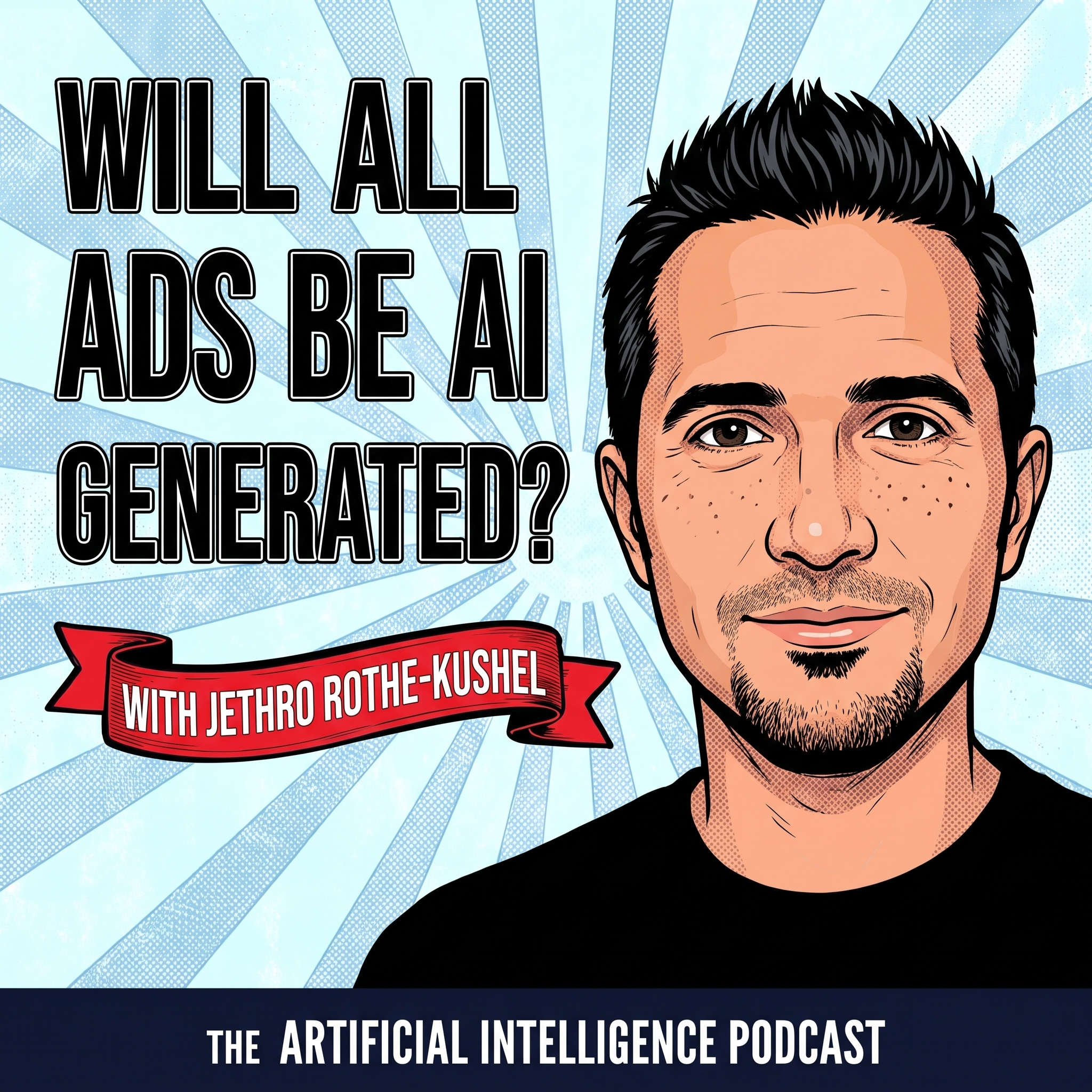
The cost of producing a commercial is dropping to zero. Jethro Rothe-Kushel, founder of Ritual Ads, has produced spots for Apple, Adidas and American Express the old way — six months to a year, seven-figure budgets, and a 40 percent success rate at the end of it — and now builds them for Reebok, Shopify and Martha Stewart with a human-directed AI pipeline. Jonathan Green talks with him about why the skill is moving from creation to curation, how a Reebok campaign that was about to be cancelled got a pre-visualization in ninety minutes and sold out the shoes within hours, why the real KPI is how fast you can get someone off the platform, and where this ends up: an audience of one.
Key Takeaways:
- The old model was slow, expensive and mostly failed anyway. Six months to a year, million-dollar-plus budgets, and roughly 40 percent of ads worked. That is the bar AI production is being measured against, not perfection.
- The skill is shifting from creation to curation. When commercials can be generated faster than you can watch them, the valuable human is the one who decides which idea is worth building, then builds it with real artists or real people.
- The Reebok proof: a launch for WNBA player Angel Reese was about to be pulled after six months and over a million dollars sunk. A ninety-minute pre-visualization saved it. They shot her against a white cyc, generated everything else, and the shoes sold out within hours.
- Brand and performance are no longer a choice. Generate data on what your customers are actually talking about, find the conversations nobody is answering, answer them with content, and measure the spend across 500-plus apps and channels.
- Human attention is too valuable to farm. Social platforms optimised for time on site; the real metric for advancing anyone is how quickly the content does its job and lets them leave.
Notable Quotes:
"We believe at Ritual Ads that the cost of production is dropping to zero." — Jethro Rothe-Kushel
"The real key metric in terms of advancing humanity is how long can we keep them off the platform." — Jethro Rothe-Kushel
Connect with Jethro Rothe-Kushel:
LinkedIn: https://www.linkedin.com/in/jethrofilms
Company: Ritual Ads — https://ritualads.com
Enjoyed this? Follow The Artificial Intelligence Podcast and send it to whoever still measures an ad by reach.
Full transcript
Will all ads in the future be AI generated? We're gonna find out today's amazing special guest, Jethro Roth Cushel. Now, Jethro, I'm so excited to have you here because my feed has been filled with AI ads and AI videos. And it feels like YouTube doesn't want to let me see anything other than AI generated content. And as someone who's in the advertising space right now, how do you kind of break through that signal to noise ratio.
Cause now there's this expectation, even if it's all original and it's really great content, people go, Is that AI generated? Like no matter how good it is. So how do you kind of see the future going and how are you starting to grab that attention? Thank you, Jonathan. It's a pleasure to be here. So, yeah, to your point, we believe at Ritual Ads that the cost of production is dropping to zero. Now, this is really interesting because my background is in both technology and large-scale production.
Apple, Adidas, American Express, large commercials. And in that role, it was frustrating because the time it would take was ridiculous. You're talking about sometimes six months to a year of time, mil over million dollar budgets. And after all of that arduous process, the success rates are pretty atrocious, 40% in the advertising space. And then I had a background in production for entertainment and television.
I was the youngest board member for the Producers Guild of America, which represents 8,700 producers for film and TV and And and also commercial production. And in that role, I realized that I wasn't alone, that it's ubiquitous. Now, the good thing about those kinds of timelines and resources is that if nothing else, there's a lot of thought and attention, right?
And so you and I were talking earlier about, kids and how they're seeing this kind of content and how it really has become ubiquitous, slop, which is challenging in a couple senses, right? There's it means that that the quality writ large is going down. And it also means that it's harder and harder to recognize sort of the the the needle in the haystack, the the the beauty, the beautiful ones, the ones that are really well crafted.
Now, at the same time, it opens up and unlocks all kinds of possibilities in this new paradigm where you can we we we have a a new product where you can go on and you can watch faster than they can be generated like the they're they're generating in real time faster than you can watch them infinite commercials for major brands. So this gets interesting and it's all happening real time without a human in the loop.
It's the opposite of maybe what you might want to do if you're thinking sort of rationally about this space, but it does unlock a lot of possibilities. We've heard a number of times that we're we're pivoting from creation to curation. And if that's the case, I think that this new paradigm really unlocks a lot for curation.
So we can watch, you know, one 30-second ad after the next after the next and have a really high-level human decide which ones are worth pursuing and then build them out either in real life with real people or build them out using AI and Real artists. And by the way, there are very high-level artists.
We have a number of artists on our team, one that did Harry Potter, you know, some of the largest music videos and commercials in the in the world that are able to take these kinds of large-scale productions and build them out for brands like Reebok or Shopify, Martha Stewart, and others. and so To be able to get the best of both worlds, where you don't have to have only an idea in your mind and wait months and and wait for green lights and corral large, you know, hundred person crews to be able to see if your idea even has merits.
You can go from an idea in your head to actually seeing it and sharing it with others within a matter of hours or minutes. And that unlocks a lot. and then at the same time, you can also just watch and curate. And that unlocks a whole nother area. So I think that now and into the future, the skill set required to really move the needle for brands is is changing and it's changing quickly. And I can speak more to that as well if you're interested.
Yeah, I love that topic because as someone who's worked with clients before, there's nothing more frustrating than working on something for three or six months. They see the first version, they go, I want something completely different.
And so having them make that decision before you go deep into the creation process, there's a lot of value to that because I'm sure you've dealt with that where you put in a massive effort and they realize they want to change it midstream or you end up doing reshoots and all of that complexity and all that work never gets out the door. No one ever sees it.
And I wonder if there's something in between those two ends of the spectrum, which is watch a thousand ads and choose and wait six months to choose, where we kind of have like a Goldilocks situation. It's too fast or it's too slow, but there's got to be something in the middle. And I'm finding this in a lot of the things that I work on where we, if you do it too fast, you don't really think about it.
And so you almost can miss some really great things. If you do it too slow, Trends can change, ideas can change. the things my kids talk about now are completely different than three months ago, six months ago, nine months ago. So a lot of cycles were very different. I know that I have some friends who worked in music videos, and music videos used to have like a million dollar budget, and then people stopped watching MTV and suddenly, you know, the budget's changed.
And the ability to do things quickly is really valuable, but it's we're entering this time now where If everything becomes built with AI, how is anyone gonna learn, go through the building process? I worked as a PA on a music video for a friend of mine. I was like, I'll do that for a day. That sounds fun. Everyone else there was like trying to work their way up.
So for me, it was like an adventure, a one-day adventure to see what happens and how video is made and to be a part of the process. But everyone else is like, you have to put in your time as a PA and then you become a head PA or then you get moved to this department or that department, then you can work in art or become a gaffer. But if we get rid of the lower levels, how do people enter any field?
If we kind of we've seen this a lot in blue collar, where we kind of got rid of internships or like apprenticeships, apprenticeships is the word I meant. And when those disappeared, now we have a mass like the average plumber in America is like 67 years old. We don't have enough plumbers. When they retire, we're gonna have a problem. And all of these industries, we lost the the training phase and now we don't know how to recover from it.
Do you think we're gonna start seeing that happen in ad creation, video creation, and other technology fields because AI is like filling in that beginner gap? I think we're creating it together. we have a very clear process.
We have interns at all times, we have assistants at all times, we have mid-level journey folks at all times, and then we have these higher level artists who have tr in in the the case today, they've learned through the traditional methods, they've worked for some of the largest campaigns in the world, and they are helping to set the bar in terms of the standards. Now I will say that oftentimes that that level is collapsing.
We'll have interns that are generating some of the the highest quality stuff because now they have access to the tools in an easy in an early way. But to to you know to your point, I think that having everyone under the same roof, under the same umbrella helps helps people learn. And it's not just The that the intern is learning from the, the the the accomplished person, but it's vice versa. And everyone is teaching each other and everyone has different strengths.
Those that are just coming out of school, now a number of them, is which is interesting, are coming out of film school and want to create films and commercials the traditional way. but what we really look for are those that are leaning into the new paradigm because oftentimes if they are AI native and they're coming right out of a film school and have tech tech chops, that that that sort of straddling those two worlds, the technology side and the creative side, without knowing the traditional production side, can unlock and afford sort of new innovations and new possibilities. so to your point, I I think that there's a lot of value in having one roof and having multiple roles learning from each other all under the same banner and umbrella.
And it's up to us to create those kinds of environments. Ever otherwise everyone's out for themselves and that has its own, you know, benefits, but it also has its own downsides as well. So with traditional filmmaking before digital film, especially, every s minute you're filming costs a certain amount of money because the film is expensive and all the components and everyone there is part of a union.
And so there was this conservatism of spend as in every minute we're doing something we know it costs, so it forces an efficiency. But it also means that you're not going to try as many experiments. If we can get it done in one take, that's better than two because it's half the money. Now with AI tools and with digital film, you can try a lot of ideas.
So do you think that with younger people, they are kind of a little freer because they haven't been through that experience where it was so restrictive. And so they don't know what's supposed to be hard and like they don't know the rules they're breaking. And so it kind of leads to these new types of ideas. Absolutely. That's a hundred percent what we're seeing. And don't underestimate the the cost of tokens.
We have a a member of our team who's just out of college, and he's driving up sometimes, you know, thousands of dollars a day in token costs. so it's not free, believe it or not, which is which is pretty wild. but it it's also, I mean, if you compare it to the old paradigm, it it it does unlock all kinds of new possibilities. And to your point. In the, in the in the olden days when when folks were shooting film, it was very costly.
And that meant that people had to be extremely strategic when it comes to setting up their shots, getting their takes and being mindful of how many takes they do. And then we moved to digital, where the cost dropped to zero. Arguably the cost in digital was even cheaper than it is now. with AI generation is in terms of a a per second cost. and so you could do infinite takes.
So that unlocked, possibilities in terms of acting. but it also maybe meant that people could relax in terms of being mindful of strategy and very specific directions. so there are upsides and downsides to each new stage. And now we unlock you can do anything in the world that you can imagine. and the cost is dropping. relatively quickly to zero, which unlocks new possibilities and has all kinds of new downsides. So, we try to amplify the upsides and mitigate the the downsides with all these things.
So at the bottom of the market, I know there are some people who are running into problems because their clients go, I can make an AI generated ad that's not as good as you, but the cost is so much lower that it equals out with our revenue. And so that's why, if you use Instagram, it's just all AI generated stuff that doesn't exist. And people are buying it. people are buying AI generated sweaters and snow globes and all sorts of horrible stuff that doesn't exist.
So Do you find that that's creating a confusion or that I find because the quality of movies has gone down significantly, the quality of the script writing and the storytelling and the complexity, the the way my children respond to movies is different than me as a kid. in every movie now, the villain is actually not really a bad guy. They're just misunderstood.
Whereas when I was a kid, they were It's clear line between good and evil or America and Russia and most of the cartoons I watched. And we're seeing that there's like a qual like everything is content now instead of quality. Are you seeing that affecting either your clients or the reception to like the con the commercials you're creating?
what we're seeing is given the commoditizing of content creation and the the value of content creation plummeting, we're really interested in two sides of the equation. one is the the the data. So what do I mean by data? We can go out and generate vast amounts of data about your brand.
We can find out what your customers are talking about in real time, what conversations they're having, and what conversations are being answered currently using the existing models of advertising, but arguably more importantly, what conversations aren't being answered. And we can answer them with content in real time. That starts to get interesting. We can also visualize all these conversations in real time, see where the gaps are. And then identify strategies to move a brand forward, both from a brand perspective and a performance perspective.
And in the olden days, you had to choose between one of those. Either you really moved the brand forward and you had brand lift, or you could really sell product and you had performance marketing. With our customers like Reebok, we We created their largest campaign launch of the year for WMBA basketball player Angel Reese's new shoe line.
It was gonna cost them over a million dollars. they'd already invested six months of time and they were gonna have to pull the plug because they had to shut down the subway station in Chicago and it was just becoming too time consuming and costly. So they came to us, we were able to deliver a pre-visualization within ninety minutes. that moved the needle, they they said, How do you how'd you have time to to shoot that?
They hadn't they weren't familiar with, they were familiar with AI Slop, but it's very different when you're using enterprise grade cinematic workflows. That's what we've mastered And so being able to unlock that, we yes, flew to Chicago, shot WMBA basketball player Angel Reese in front of a white psych.
Everything else in the world was AI generated. so That unlocked the possibilities in terms of that you that you can both move the needle, yes, from a time and cost perspective, but also the ultimate commercial ended up selling out the shoes within hours, which they'd hadn't experienced in recent times. So it moved the needle forward both from a brand and a performance perspective. And created the the real life possibility that yes you you can have your cake and eat it too.
Yes, it can be you know more cost effective and less time consuming, but also higher quality. because we believe that that's that's where the the gems lie. So back to the data. So we use data on the front end to be able to pre-visualize and create strategy. And then we flow it out The we we actually can handle the ad spend to over 500 apps and channels, collect all of that data, per super personalized data.
We know who you are, your age, your gender, proxies for income and net worth and interests. and that that you might think, you know, is exclusive to Meta, but we but but we unlock that using CTV. and we know how long you're watching these ads, if you're scanning a QR code, and then we feed all of that data back into the system to create better and better results for our customers.
And for a long time, direct response marketers were very aware of the response to their ads and doing that. But larger brands tend to just create content and not pay attention to results. So it's really interesting that you're starting to bring those things together to the larger enterprises where they like are paying attention to which ad campaign works or doesn't. One of the challenges with advertising is it's always been about forecasting, which is like guessing. You produce however many units you think you're gonna sell.
And you have to play if you have to plan your ad campaign six months in advance, how people feel about the NBA now is very different than how they felt six months ago. So, to forecast where someone's gonna be in six months is really, really high risk and challenging and all the complexity to plan out an ad campaign and then find out, we gotta close down the subway station. We can't, we've lost all this time and money. Do you think that we're gonna see?
More and more immediacy. I know there's already talk about having individualized ads where the ad says my name, which is my worst nightmare and that's too much for me. But I know that a lot of people will respond to that, which means this is gonna happen.
So do you think we're gonna we're moving towards more and more immediacy and that this allows brands to maybe have less misfires because they don't have to plan six months in advance, they can figure out what's popular now and have an ad out within a few days. Yeah.
So to your point, what this new paradigm does unlock is speed at the at the speed of culture, you're able to respond to customers where they are now. and also to your point, you know, it's very much in our product pipeline to be able to to narrow and narrow and narrow the how large the audiences are that we're ultimately speaking to until we eventually get to an audience of one. We can do that today.
The the challenge is the technology for distributing it and the infrastructures for distributing it is not quite there. And it it is, you know, it is costly. You're talking about you know, dollars certainly for a generation for individuals. so so the the but but all of the parts of the infrastructure are being built if they haven't already been built.
And so there's no question that that's where this eventually leads. that opens up all kinds of possibilities, not just in the ad space, by the way, but in the entertainment space. And this sounds counterintuitive, but in the medical space, for medtech, what do I mean by that? There's a growing field of medicine called narrative medicine, which suggests that stories can cure problems in the body. We know that from Go into the movies, we watch something, it's heartwarming. It taught us something about our relationship.
We can go back and be a better father, a better mother, a better parent, et cetera, because we were able to see something play out, you know, a resolution to a problem on screen. So that's sort of the psychological component that we all understand. but it turns out there's also physiological components. So in some cases, there's been documented cases of cancer.
Which have been cured through narrative medicine, which sounds crazy. but if if you if if you buy into that, cinematic stories are the most powerful kinds of stories we as humans have ever created.
So what if we could create a story made just for you based on your data, you know, the data that's following us with our devices, that knows what we how much we moved yesterday, what we did. yesterday it knows about our context in terms of a lot of the emails that we've been sending and other things.
And we could create a story where you can experience love, truth, joy, abundance, health, and have that experience be as short as possible and have that experience last with you, not just while you're with the content, but long after. And what if we could deliver that To billions of people around the planet at scale. To me, that's that's sort of a mission worth driving towards. We're we're not there yet, but I think that the building blocks towards that are being made as as we speak.
And that's really, you know, I think it's incumbent upon all of us as leaders in AI to decide the kinds of outcomes in advance we're committed to and to then work. day after day, month after month, year after year, decade after decade, to ensure that those visions come to fruition. In a lot of niches, we're chasing quantity over quality.
Netflix is about how many minutes have people watched this month and how many minutes of shows have we created versus creating like one really good movie or two really good movies. There's this thought about volume and it's It's big in advertising and there's always you have to see an ad this many times before people respond to it. But I always think, Well, what if it's a good ad? if it's something Right.
that solves a problem I have right now and it's something I want, I don't need to see the ad fifty times. It's this it Yeah, human attention is too valuable. and and and I think that's where a lot of the social media companies and others got confused, where the key metric was all about how long can we keep them on the platform. Whereas we all know the the real key metric in terms of advancing humanity is how long can we keep them off the platform?
Have the platform do what it needs to do, but in in as short a period of time as possible. That's the that's the KPI we're committed to. Yeah, if we just you wouldn't have to see as many ads if they were the right ads, and then it'd be less annoying.
And I just think that with a lot of social media apps and a lot of the tools out there, they just they measure always and even clients I deal with, they measured the wrong number, which is like, Well, how many people I had a someone work with social media match working once he's like was talking about reach. I like, What's reach? He's like, How many people could have seen your post? I was Well, how many people did see it? 'Cause like Yeah.
Could have is the craziest metric to me. It's like, I could have had a thousand friends in high school, but I didn't. Yeah, yeah, everyone in the world could have seen it. Yeah. And it's like we have these hypotheticals, and it's like, especially on these, there's certain social media platforms is like 50 posts on the page at once, and you're scrolling down. It's like, what was on there in their scrolls?
I didn't even see it, and it's my own ad. so we are selling what is it, a fraction of attention? Cause you you have 50 things on the page, you don't even see it. And so I think in the same way that we think salespeople are annoying, unless they're selling something you want and actually helping you and then they're not annoying, we Yeah.
If if they're selling something that you not only want but actually need and is good for you, that's that's the intersection of, you know, sales and driving humanity forward. And that's that's what I'm interested in. And it's it it it it is the same skill, but pointed at a positive behavioral outcome. Yeah, I like that.
I think it's very interesting because I always I remember when I was buying the camera that I used to record these and I said to my friend, which camera should I get? He told me three to choose from. I was like, no, I didn't don't do that. Don't give me more work. Now like just tell me which one. Like, let's make it easy.
And I think that is like the purpose of sales marketing ads is like just tell me which is the one that solves my problem. Tell me what your product does, what problem it solves. And I asked this question of so many startups I talk to. I'm like, what problem do you solve? And if they can't tell me, I'm like, and I was on a call with a c a potential client a few weeks ago and I like, I've been on your website for an hour.
I can't figure out what you do. You have a major problem. You have a major problem here. Like That's a problem. Yeah, that's a problem. And to your point, a good salesperson is, you know, oftentimes you will hear salespeople say, Well, it all depends on you. You know, can you can have any of these. it really depends on what you want. But I to your point, I think a a good salesperson is able to identify which is right for you.
So that's why discovery is so important and really getting to know the customer and then based on an understanding of the customer. There is a correct fit between a product and a customer. And so the the the elevated salesperson is able to decipher what it is and and actually do a good job at dec at delivering the right product to the right customer.
And that's what in in the best kind of marketing can also do is really repel. the the wrong customer and attract the right customer and and more and more only be delivered. the the the the content itself and the marketing itself should only be delivered to the right customer from the get go. Yeah, I just think that I hope it goes that way 'cause far too many companies want to put ads everywhere.
And it's like They're just chasing volume versus the right person or the right quantity. And the thing is you start to get ad blindness or banner blindness where you block block every ad and then they ban ad blockers. And it's like, well, now it's an arms race. It's going in the wrong direction. It's like you're forcing me to watch an ad I don't want to watch. That's not gonna work.
And that seems like, chasing these wrong things where it's like, yeah, the real metric, at least to me, is revenue. So when you're writing an ad campaign, it's like you said, how many shoes did you sell or how much revenue did you join for what the ad costed? But it's like we get distracted by these gamification factors. And I always think about I blame Facebook for all this because when they started calling your connections friends, I remember people like, I have 500 friends.
And I like, I know you, you definitely don't. Like, Ha ha. you know what I mean?
It's like, and that that changed, that was the first gamification we had in social media because it used to be connections or like on MySpace and then Facebook came up with friends and people started having imaginary friends or online only friends and it changed everything and we start to chase volume and it's like you can have eight friends who really know you or five hundred friends who barely know you and Or one friend who really cares. Yeah, that's much better. I love that.
Well, I like what you're doing. I think it's really, really interesting to kind of see the intersection of AI and to talk to companies that aren't just firing everyone and replacing them with AI. So there's a happy medium where you can have a human in the loop where you can have a team that's accelerated with AI instead of replaced by AI, which I think is a better future. And I think that is where things are gonna go.
For people that are kind of interested in what you're doing, want to see more of your ads, and maybe even want to see your adds the second platform and the cool things you're doing for self-serve. Tell us about the best place to find you online and some of the stuff you're working on. Yeah, join us at ritualads.com, r-i-t-u-a-l-a-d-s.com. ritual, why ritual? I'm asked often. So I I studied, among other things, religious studies.
So it turns out humans across time and across places have really leaned on this power of ritualized storytelling throughout time. It's what gives us meaning, it's what drives us to action. And so we're incorporating. the ancient tried and true powers with the future of cinematic storytelling through ritual ads. So yeah, visit us online. We'd love to, we'd love to see you. We'd love to connect. We have a platform where you can go in and create your own cinematic ads and stories.
And yeah, we'd love to, get to get to know you better. So thank you. And thanks Jonathan for inviting me to the to the show. It's been a it's been a real pleasure. thank you so much for being here. I really appreciate it, Jethro. This was a great episode of the Artificial Intelligence Podcast.